
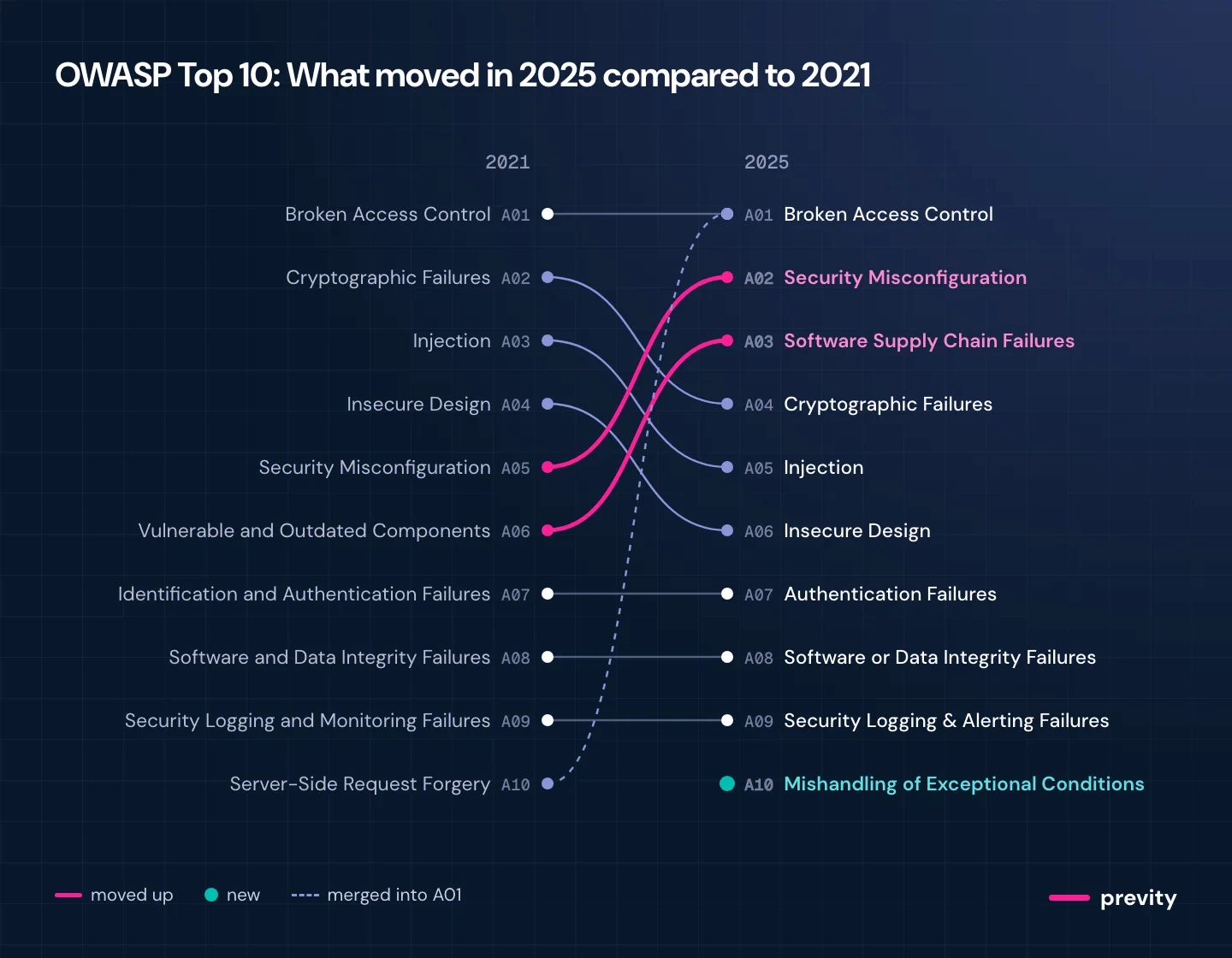
The OWASP Top 10 2025 are the ten most important risk categories for web applications. New this time: the software supply chain as its own category at number 3, and the handling of errors and exceptional conditions at number 10. Security misconfiguration jumps to number 2. It is still not a checklist: for that, OWASP itself points to the Application Security Verification Standard (ASVS).
What the OWASP Top 10 are and what they are not
The Open Worldwide Application Security Project (OWASP) has published the Top 10 since 2003. They show development teams, architects and management where web applications are most often vulnerable.
OWASP explicitly calls the list an "awareness document". Used as a coding or testing standard, it is "the bare minimum and just a starting point". OWASP also discourages any claim of full coverage of the Top 10, "because it's simply untrue" (OWASP Top 10:2025, establishing an AppSec program).
The reason is the structure. A category like "Broken Access Control" describes a risk, not a verifiable requirement. Whether your application "passes" it cannot be decided.
The ten categories of 2025 at a glance
| Rank 2025 | Category | Rank 2021 |
|---|---|---|
| A01 | Broken Access Control | 1 |
| A02 | Security Misconfiguration | 5 |
| A03 | Software Supply Chain Failures | new, expands A06:2021 |
| A04 | Cryptographic Failures | 2 |
| A05 | Injection | 3 |
| A06 | Insecure Design | 4 |
| A07 | Authentication Failures | 7 |
| A08 | Software or Data Integrity Failures | 8 |
| A09 | Security Logging & Alerting Failures | 9 |
| A10 | Mishandling of Exceptional Conditions | new |
Source: OWASP Top 10:2025, introduction.
What changed since 2021
- New at number 3: the software supply chain. A03 expands the former category "Vulnerable and Outdated Components". It is no longer just about outdated libraries, but about the whole chain of dependencies, build systems and distribution.
- New at number 10: errors and exceptional conditions. This covers applications that react insecurely when something fails, for example by exposing internal details or granting access instead of denying it.
- SSRF moved into A01. Server-side request forgery is no longer a category of its own but part of access control.
- Misconfiguration rises from 5 to 2. Cryptography drops from 2 to 4, injection from 3 to 5, insecure design from 4 to 6.
- Two renames. A07 is now just "Authentication Failures", A09 adds alerting to logging.
The data set is much larger than in 2021: data from more than 2.8 million applications and around 175,000 CVE records mapped to CWEs. The ten categories cover 248 CWEs. Eight categories come from this data, two from a survey among practitioners: the supply chain (A03) and logging and alerting (A09). OWASP includes them because testing data does not yet capture these risks well, even though they matter in practice.
A03 Software Supply Chain: why dependencies are now number 3
A typical application consists mostly of other people's code. Every library brings its own dependencies, and each of them can contain a known vulnerability or be compromised.
For manufacturers of digital products, this becomes an obligation. Annex I, Part II, No. 1 of the Cyber Resilience Act requires manufacturers to identify the components of their product and draw up a software bill of materials (SBOM) in a commonly used, machine-readable format, covering at least the top-level dependencies (Regulation (EU) 2024/2847). The German BSI describes what such an SBOM should contain in Technical Guideline TR-03183-2.
The first step is unspectacular: knowing which component in which version is part of your application. Without that list, you can neither match a new vulnerability report nor show whether you are affected.
A02 and A10: what shows in the code and what only shows in operation
Misconfiguration and error handling show well where static checks help and where they don't.
Visible in code and configuration, for example:
- debug modes and verbose error output enabled in production configurations
- default passwords and hard-coded credentials
- error handling that returns stack traces or internal paths to users
- exceptions that are caught and ignored, so a check is simply skipped when something fails ("fail open")
Only verifiable in operation are open ports, the actual configuration of cloud services, or whether an alert really reaches someone. That needs tests of the running environment.
From a list to verifiable requirements: OWASP ASVS 5.0
For anything you need to prove, OWASP recommends the Application Security Verification Standard. According to OWASP, it is "designed to be verifiable and tested". Version 5.0 was released in May 2025 and contains 345 requirements in 17 chapters, in three levels: level 1 as the minimum, level 2 for most applications, level 3 for the highest protection needs (OWASP ASVS).
The difference: an ASVS requirement has something to check. Either it is implemented in the code or it is not, and a finding can be traced to a location. As a guide to where the Top 10 risks are mainly verified in ASVS 5.0:
| Top 10 2025 | ASVS 5.0 chapters (selection) |
|---|---|
| A01 Broken Access Control | V8 Authorization |
| A02 Security Misconfiguration | V13 Configuration |
| A03 Software Supply Chain Failures | V15 Secure Coding and Architecture |
| A04 Cryptographic Failures | V11 Cryptography, V12 Secure Communication |
| A05 Injection | V1 Encoding and Sanitization |
| A06 Insecure Design | V2 Validation and Business Logic, V15 Secure Coding and Architecture |
| A07 Authentication Failures | V6 Authentication, V7 Session Management, V9 Self-contained Tokens, V10 OAuth and OIDC |
| A09 Security Logging & Alerting Failures | V16 Security Logging and Error Handling |
| A10 Mishandling of Exceptional Conditions | V16 Security Logging and Error Handling |
This mapping is a guide, not an official OWASP mapping. Many risks touch several chapters.
Where regulation meets the Top 10: CRA, NIS2, ISO 27001
No law requires the OWASP Top 10. In substance, though, the categories match what regulation asks of software:
- Cyber Resilience Act: Annex I, Part I requires, among other things, that products are delivered without known exploitable vulnerabilities, with a secure default configuration, protected against unauthorised access and with logging of security-relevant events. That matches A01, A02, A03, A07 and A09. Reporting obligations apply since 11.09.2026, the regulation applies in full from 11.12.2027. More on our CRA page.
- NIS2: Art. 21 of Directive (EU) 2022/2555 requires security in the acquisition, development and maintenance of systems, including vulnerability handling, and control of the supply chain. Germany has implemented NIS2 since 06.12.2025. More on the NIS2 page.
- ISO/IEC 27001:2022: Annex A 8.25 to 8.29 cover secure development, including 8.28 "Secure coding" and 8.29 "Security testing in development and acceptance". Your management system defines which controls apply; their implementation must be evidenced. More on the ISO 27001 page.
If you supply financial institutions, the same questions also reach you through DORA.
How development teams make good use of the Top 10 2025
- As a learning list. The Top 10 work well for training and as a focus in code reviews. New team members quickly understand what matters.
- Use the ASVS for evidence. Decide which level fits your protection needs and check against the requirements of that level.
- Check code and documentation together. Many requirements concern both: what is in the code and what is defined in policies and architecture.
- Fix findings with their location. A finding without file and line is rarely fixed.
- Keep the status across several checks. Customers, auditors and investors don't ask once, they ask again and again.
Automation has limits: whether an application's business logic is secure or an architecture decision holds still needs human judgement.
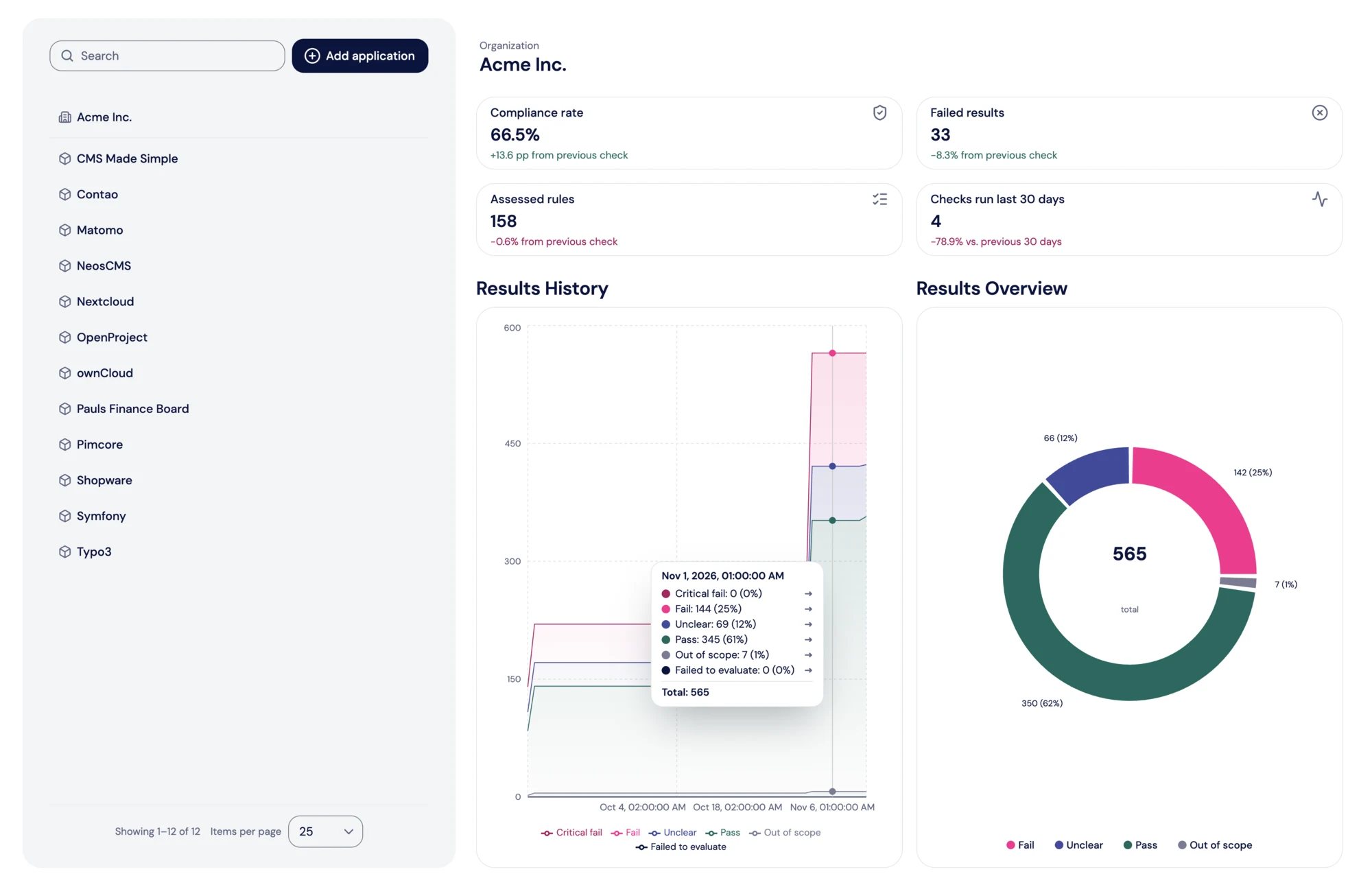
Previty automatically checks code and documentation against the requirements of standards such as the OWASP ASVS, shows findings with their location in the code and keeps the history across several checks. We'll show you what that looks like for your application in a personal demo.